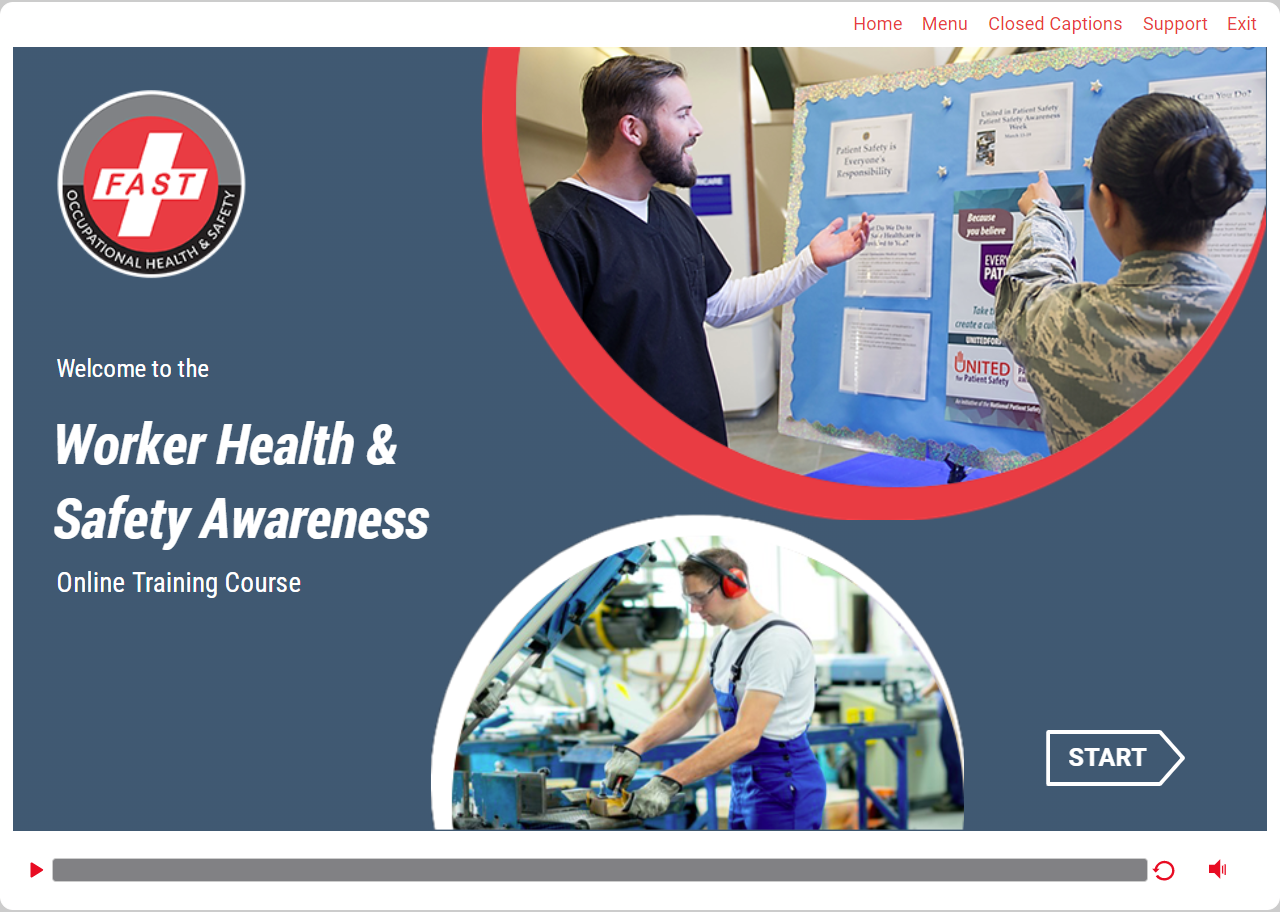
Worker Awareness
(E-SWAT-E)
Introduction to Worker Awareness Training Online Training Course
Occupational Health and Safety (OHS) – Online Worker Health and Safety Awareness Training
This course is suitable for all workers, including new hires, seasoned employees, and supervisors, across various industries.
The course is fully narrative, and AODA-Complaint which describes each and every chapter in a comprehensive manner using relevant images.
You can stop the course at any time and pick up where you left off. Also, a final test is offered to gauge your understanding. If you successfully pass this final test, you will get a completion certificate that will help you in your career.
WORKER HEALTH AND SAFETY AWARENESS TRAINING COURSE OUTLINE
1. INTRODUCTION
The introductory chapter describes that everyone in the workplace bears a responsibility for ensuring health and safety. The entire workforce reaps the benefits when safety takes precedence as the ultimate objective.
It also highlights that this training holds great significance as it imparts fundamental knowledge of health and safety applicable to all work environments. However, it does not absolve your employer of their responsibilities under the Occupational Health and Safety Act to provide job-specific information and instructions on ensuring your safety.
2. OCCUPATIONAL HEALTH AND SAFETY ACT
The Occupational Health and Safety Act (OHSA) encompasses a collection of laws and corresponding regulations that must be adhered to in all workplaces.
The OHSA outlines the duties of employers, supervisors, and workers across all workplaces. Moreover, specific regulations exist depending on the nature of the workplace, including:
Industrial regulations refer to laws, rules, and standards established by government agencies or regulatory bodies to govern and oversee various aspects of industrial activities.
Construction regulations are laws, rules, and standards established to govern and oversee activities in the construction industry.
Health care and residential facilities regulations refer to the laws, rules, and standards established to govern and oversee activities within healthcare and residential facilities.
Mines and mining plants regulation refers to the laws, rules, and standards established to govern and oversee activities in the mining industry.
In this chapter, you will learn details about the topics mentioned above.
3. DUTIES AND RESPONSIBILITIES
Duties and Responsibilities encompass various tasks and obligations that individuals within an organization are required to fulfill to ensure the well-being and protection of themselves and their colleagues in the workplace. In this chapter highlights that every individual within the workplace carries duties and responsibilities towards one another.
Employers and supervisors have the duty to take every reasonable precaution to prevent workers from falling ill or getting injured on the job site. Workers, on the other hand, have the duty to utilize the provided Personal Protective Equipment (PPE) and adhere to the safe operating procedures they have been trained on.
The following chapters are included in duties and responsibilities:
Employer duties and responsibilities refer to the obligations that employers have towards their employees, as well as towards maintaining a safe and fair work environment.
Supervisor duties and responsibilities encompass the tasks and obligations that supervisors are expected to fulfill in their role overseeing and managing employees.
Worker duties and responsibilities encompass the tasks and obligations that employees are expected to fulfill in their roles within an organization.
In this chapter, you will learn details about the topics mentioned above.
4. PERSONAL PROTECTIVE EQUIPMENT (PPE)
PPE is specifically designed to safeguard workers against potential hazards present in their respective workplaces.
Various types of PPE include hair nets, rubber gloves, dust masks, aprons, hearing protection, safety boots, and goggles/safety glasses. It is the responsibility of your employer to provide training on the proper usage and maintenance of your PPE.
Once you have received instructions on how to use your PPE, it is essential to wear it consistently when performing tasks that require its use.
5. WORKPLACE HAZARDS
Workplace hazards are potential sources of harm or danger present in the work environment that have the potential to cause injury, illness, or other adverse effects to employees. Common workplace hazards include:
Machine guarding hazards refer to potential dangers associated with the lack of or improper use of machine guards in industrial settings.
Chemical and biological hazards refer to potential dangers posed by exposure to hazardous chemicals or biological agents in the workplace.
Physical hazards refer to potential dangers in the workplace that can cause harm to employees through physical means, includes radiation, temperature, vibration and noise.
Energy hazards refer to potential dangers in the workplace associated with the release or transfer of energy.
Material handling refers to the movement, storage, control, and protection of materials and products throughout various stages of production, distribution, warehousing, and transportation processes.
In this chapter, you will learn details about the topics mentioned above.
- Worker Awareness
- Download Certificate
Student Reviews
Feedback from students who have taken this course.