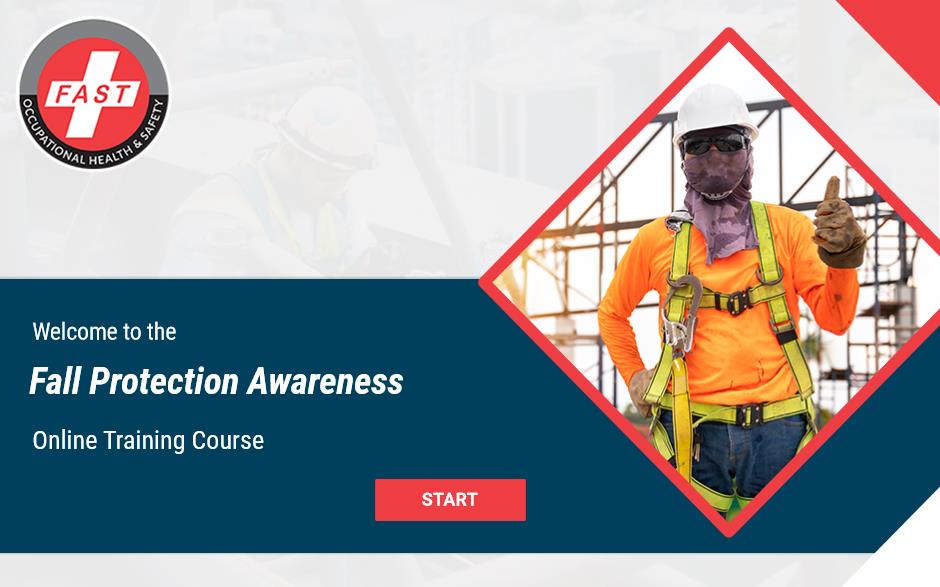
Fall Protection Awareness
(E-SFPC-E)
Introduction to Fall Protection Awareness Online Training Course
Occupational Health and Safety (OHS) – Online Fall Protection Training Course
Once you start the course, you can pause it as needed. The course will automatically bookmark and you can resume it where you left off. The course is fully narrated and is AODA compliant.
The topics are explained in detail, represented by relevant images and activities to confirm understanding. At the end of the module, there is a summary along with a practical training checklist. At the end of the course, there is a final test to assess your understanding of the topic.
FALL PROTECTION TRAINING COURSE OUTLINE
MODULE 1: INTRODUCTION
The introductory chapter explains falls and fall protection. This chapter focuses on the
1. Anatomy of a fall, fall hazards, elimination, prevention and the control of falls
2. The types of fall hazards, including falls from ladders, scaffolds, buckets, towers, work platforms, etc.
3. Elimination, prevention and control of falls
MODULE 2. SLIPS, TRIPS AND FALLS
Slips, Trips, and Falls refer to accidents caused by losing footing, stumbling, or falling. This chapter covers:
1. Falls on level surfaces, falls from elevation, and falls from ladders
2. Tips on the proper use of ladders and effective ways to avoid slips, trips and falls
MODULE 3. FALL PROTECTION EQUIPMENT
Fall Protection Equipment refers to specialized gear designed to prevent or minimize the risks of falls from elevated positions. In this chapter, the fall protection equipment, such as guardrails, travel-restraint systems, fall-restricting systems, fall-arrest systems, and safety nets are explained in detail along with the provincial height requirements for fall protection.
The CSA (Canadian Standards Association) standards, personal fall arrest system (PFAS), fall-restraint system, positioning device systems, personal fall protection systems, body/waist belts, safety nets, safety monitoring systems, warning line systems, catch platforms and controlled access zones are also covered.
MODULE 4. ANCHOR SYSTEMS
Anchor Systems are specialized structures or points designed to securely attach fall protection equipment. In this chapter, the three basic types of anchors (designed fixed support, temporary fixed support, and existing structural features) are explained along with the safety factors. Anchorage, clearance, pendulum effect and improper anchorage points are also discussed in detail.
MODULE 5. COMPONENTS OF A SYSTEM
Components of a System refer to the various essential parts or elements that collectively make up a fall protection system. This chapter discusses several components of a fall protection system such as connectors, rope grabs, carabiners, locking snap hooks, full body harnesses, lanyards, shock absorbers, and lifelines (horizontal and vertical). The rope-breaking strength standards, loss of rope strength from knots, self-retracting lifeline and impact indicators are reviewed.
MODULE 6. INSPECTIONS
Inspections involve a systematic examination or evaluation of fall protection equipment, tools, or systems to ensure they meet safety standards and are in proper working condition. This chapter discusses the fall equipment inspections for damage, wear and other defects. Detailed inspection procedures are explained for the inspection of harnesses (webbing, buckle, d-rings), lanyards (snap hooks, steel lanyards, web lanyards, rope lanyards, shock-absorbing packs), webbing and rope lanyards.
MODULE 7. STORAGE AND MAINTENANCE
Storage and Maintenance cover the proper handling, safekeeping, and upkeep of fall protection equipment, tools, or systems. This chapter covers important storage and maintenance guidelines to follow for personal fall arrest equipment.
MODULE 8. DONNING HARNESSES
Donning Harnesses refers to the process of putting on or wearing safety harnesses. Full body harnesses are designed to provide the wearer with maximum comfort while maintaining the highest degree of protection from falls. For the harness to be fully effective, it must be adjusted properly to fit the wearer, and must be attached to an appropriate personal fall arrest system. This chapter explains the detailed procedure on wearing a full body harness.
MODULE 9. FALL PROTECTION PLAN
The Fall Protection Plan is a comprehensive strategy or set of guidelines implemented in workplaces where individuals are exposed to fall hazards. This chapter reviews the situations where fall protection plans are needed. Detailed scenarios are described. You will understand the fall protection plans needed for rescue training, suspension trauma, suspension trauma straps, aerial lifts and connecting elevated work platforms.
- Fall Protection Awareness
- Download Certificate
Student Reviews
Feedback from students who have taken this course.