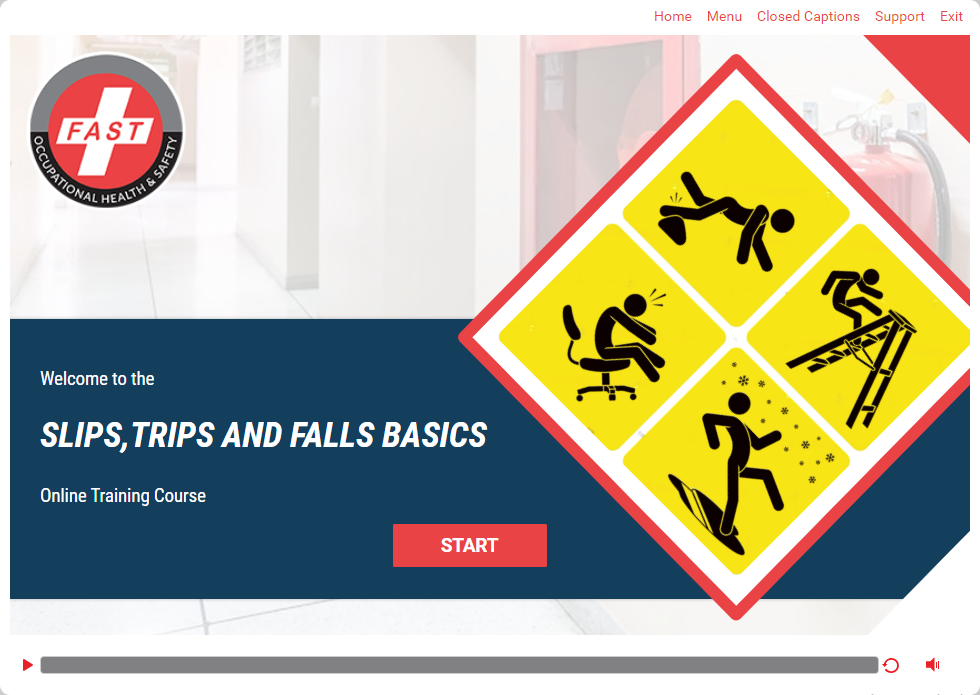
Slips, Trips and Falls Basics
(E-SSTB-E)
Introduction to Slips, Trips and Falls Basic Online Training Course
Occupational Health and Safety (OHS) – Online Slips, Trips and Falls – Basics
Once you start the course, you can pause it as needed. The course will automatically bookmark and you can resume it where you left off.
The course is fully narrative and ADA compliant. The topics are explained in detail, represented by relevant images and activities to confirm understanding.
At the end of the module, there is a final test to gauge learners understanding.
SLIPS, TRIPS AND FALLS – BASICS TRAINING COURSE OUTLINE
1. INTRODUCTION
The chapter discusses the significant issue of workplace injuries caused by slips, trips, and falls.
According to the Canadian Centre for Occupational Health and Safety (CCOHS), these types of accidents are a leading cause of workplace injuries and affect more than 42,000 workers each year.
Additionally, slips, trips, and falls are responsible for 17% of all lost-time injuries, according to the Association of Workers’ Compensation Boards of Canada.
The chapter highlights the importance of implementing measures to prevent such incidents in the workplace to ensure the safety and well-being of employees.
2. SLIPS
A slip happens when you unexpectedly lose grip between your shoes and the ground, causing your foot to slide, which can lead to falls or injuries.
The chapter provides information about slips, which occur when a person loses grip with the surface they are walking or standing on.
Slip hazards can arise from various sources, such as ice, oil, or other liquids that make the ground wet, as well as objects like banana peels or any other material that reduces the friction between the feet and the surface.
These hazards can increase the risk of slip and fall injuries in the workplace, which can cause significant harm to employees. Understanding and identifying slip hazards is critical for implementing preventive measures to ensure a safe working environment.
3. TRIPS
A trip occurs when your foot hits an object or an uneven surface unexpectedly, causing you to stumble or lose balance.
This chapter provides information about trips, which occur when a person stumbles over an object or trips on a surface irregularity.
Trip hazards can include objects such as holes or tools in a walkway or conditions such as loose steps, poor lighting, or inattentiveness, which increase the likelihood of tripping.
Tripping hazards can lead to serious injuries in the workplace, and it is essential to identify and eliminate such risks to ensure the safety of employees.
Proper maintenance of the work environment, adequate lighting, and regular inspections can help prevent trip hazards and protect employees from workplace injuries.
4. FALLS
A fall is when someone loses their balance accidentally and ends up on the ground or at a lower level, often resulting in injury.
This chapter provides information about falls, which refer to vertical drops from a surface above ground level, such as a platform, scaffold, roof, or ladder.
These types of falls can occur due to slips, trips, or other incidents, such as a worker tripping over an extension cord while working on a roof, causing them to fall off the roof.
Falls from heights can lead to severe injuries or fatalities, making it crucial to prevent such incidents in the workplace. Employers should ensure that employees have the necessary training and equipment to safely work at heights, including fall protection systems, guardrails, and other protective measures to prevent falls.
Regular maintenance and inspection of equipment and work environments can also help identify and mitigate fall hazards to promote a safer workplace.
5. PREVENTING SLIPS, TRIPS, AND FALLS
Preventing slips, trips, and falls is essential for maintaining safety in various environments. These training programs promote a safety culture where everyone is responsible for identifying and addressing potential hazards, further strengthening accident prevention efforts. Learn the general principles for preventing slips, trips, and falls in this chapter.
6. PROACTIVE PREVENTION PLAN FOR SAME LEVEL FALLS
Proactive measures to prevent same-level falls include:
Hazard identification is the process of recognizing potential dangers or risks in a given environment or situation.
Hazard assessment involves evaluating potential risks and dangers within a given environment or situation.
Hazard control refers to the implementation of measures or actions aimed at reducing or eliminating identified hazards within a particular environment or situation.
In this chapter, you will learn detail on the above mentioned topics.
7. PROACTIVE PLAN FOR VERTICAL FALLS
A proactive plan for vertical falls includes installing guardrails.
Identifying vertical fall hazards involves assessing potential risks associated with working at heights or near vertical edges.
Assessing vertical fall hazards involves evaluating the potential risks associated with working at heights or near vertical edges.
Controlling vertical fall hazards involves implementing measures to mitigate the risks associated with working at heights or near vertical edges.
In this chapter, you will learn details about the topics mentioned above.
8. IMPLEMENTING AND MONITORING
This process ensures that strategies and controls are properly executed, allowing for adjustments to be made as needed to maintain safety and effectiveness.
Monitoring fall hazard controls involves regularly assessing and evaluating the effectiveness of measures implemented to mitigate the risks associated with falls.
Documenting fall hazard prevention involves keeping records of all measures taken to mitigate the risks associated with falls.
In this chapter, you will learn details about the topics mentioned above.
9. SUMMARY
Slips, trips, and falls are common workplace accidents that can cause injuries to employees. Slip hazards involve wet or slippery surfaces, while trip hazards include objects or uneven surfaces that can cause stumbling. Falls occur when someone drops from an elevated surface like a platform or ladder. Employers can prevent these incidents by identifying and removing hazards, providing employee training and safety gear, maintaining work areas and equipment, and fostering safety awareness among workers. These preventive measures help create a safer workplace and reduce the risk of slips, trips, and falls.
10. FINAL TEST
The final test assesses learners’ understanding and knowledge acquired during the training. It covers topics including the roles and responsibilities of committee members, meeting procedures, safety regulations and standards, and emergency response protocols.
The test format may involve multiple-choice questions or selecting the correct answers. Its purpose is to ensure learners have grasped the key concepts of the training and can apply them proficiently in the workplace.
- Slips, Trips and Falls Basics
- Download Certificate
Student Reviews
Feedback from students who have taken this course.