Traffic Control Awareness
(E-STCA-E)
Introduction to Traffic Control Awareness Online Training Course
Occupational Health and Safety (OHS) – Online Traffic Control Training and Certification
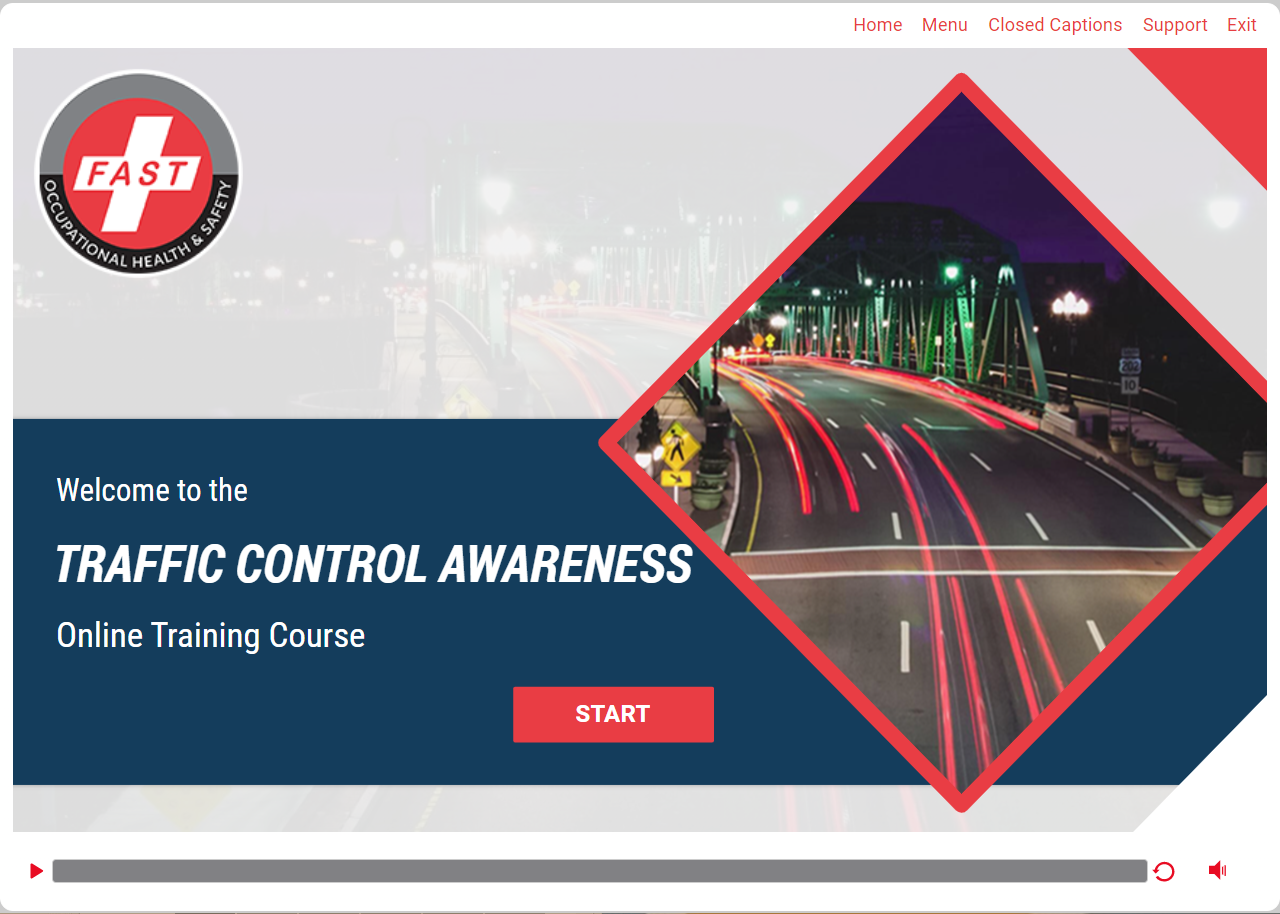
This course covers detailed information about TCPs’ on-the-job responsibilities, ways of communicating with the public, regulations, and standards.
After commencing the course, you have the flexibility to pause it whenever necessary. The course will automatically create a bookmark of your progress so that you can easily resume from where you left off. Additionally, the course is fully narrated and adheres to the Accessibility for Ontarians with Disabilities Act (AODA) guidelines.
The topics covered in the course are elaborated in great detail, accompanied by pertinent images and interactive activities to ensure comprehension. Upon completion of the course, a final assessment test will be administered to evaluate your grasp of the subject matter.
TRAFFIC CONTROL TRAINING COURSE OUTLINE
The course covers the following topics:
1. INTRODUCTION
This introductory chapter provides information about the overall purposes the traffic control is intended for.
2. TRAINING
Regulations require that all Traffic Control Persons (TCP) be given written and verbal instructions. In this chapter, you will learn that this course is meant in part to help you meet that requirement.
3. QUALIFICATIONS
The specific attributes, skills, and requirements expected of individuals serving as Traffic Control Persons encompass a range of qualifications essential for their role. Learn the different attributes the traffic control people should have in addition to training. These are the qualifications that are needed by TCPs to perform their tasks effectively.
4. LEGAL AUTHORITY
The ministry has the authority and regulatory power to manage transportation-related matters within the specified region. Learn about the Ontario Ministry of Transportation (MTO):
- Its legal authority and responsibility to regulate and control traffic
- How MTO controls safety in the work zones
- Its authority to regulate traffic controls and devices; warn or guide traffic
5. STANDARDS
In this chapter, you will come to know that the requirements for traffic control, including an in-depth description of requirements, procedures, and duties of a traffic control person, are spelled out in the Ministry of Transportation (MTO) Ontario Traffic Manual, Book 7 Temporary Conditions.
6. REGULATIONS
In this chapter, you will learn detailed information about the regulation – O. Reg. 213/91, such as:
- Traffic protection plan
- A worker’s responsibilities while setting up or removing measures on a roadway or a shoulder of a roadway
- Installation of adequate barriers
- Measures taken to protect a worker at a project if the project is on a freeway and involves a mobile operation
- Guidelines in directing vehicular traffic
- Worker’s qualifications for directing vehicular traffic
- Upper body garment features
- Illumination of TCP and equipment
7. TRAFFIC CONTROL PERSONNEL - PERSONAL PROTECTIVE EQUIPMENT
Personal protective equipment emphasizes the necessary safety gear for individuals involved in traffic control. Learn about the supervisors’ responsibility to ensure that Traffic control people (TCPs) wear personal protective equipment (PPE). Various PPE requirements that TCPs must follow are explained in this chapter.
8. GETTING STARTED
In this chapter, you will learn about the key information that each TCP must understand before starting the work. This information is broadly related to:
- Type of construction such as paving, installing pipe, grading
- Type of equipment to be used – scrapers, trucks
- Equipment operation – crossing roads, in culverts
- Directing public traffic
9. ON THE JOB
In this chapter, you will learn about the priority things that need to be checked each day prior to the start of shift.
Also learn the three categories the work zone devices are divided into:
Detailed illustrations are displayed in this chapter for sign quality, barrel quality and traffic cone quality.
- Acceptable
- Marginally Acceptable
- Unacceptable
10. TRAFFIC CONTROL PERSONNEL - TOOLS
Traffic control personnel tools refer to essential equipment for safely directing traffic. In this chapter, you will learn about the tools for hand signalling.
11. TCP POSITION AND LOCATION
TCPs must be clearly visible to the approaching motorist at all times. The TCP should be located for good visibility and contrast, so that the motorist does not have to compete for visual attention with other illuminated or reflective objects.
In this chapter, you will also learn the guidelines that TCPs must follow regarding their position and location.
Detailed illustrations are provided in this chapter to cover different aspects:
- A typical arrangement on a two-lane roadway. The location of the TCP and the distance from work area are also highlighted.
- A TCP table showing traffic control person distance from work area
- Positioning of TCPs on a straight road
- Positioning of TCPs on a curved roads and hills
12. HOW TO SIGNAL
Learn how to signal vehicles to avoid accidents/injuries.
Precise information is provided along with relevant images that describes how to signal a vehicle using distance in metres for safe driving:
- Stopping Vehicles
- Slowing Vehicles
- Moving Traffic from Stopped Position
13. COMMUNICATION
In this chapter, learn the various ways of communication that TCPs should practice to avoid disturbances or distractions. It also describes the precautions while following two-way radio type of communication or when two TCPs are working together.
14. PROBLEMS
This chapter hints you that you are not a law enforcement officer. You will need to follow the prescribed guidelines when problems arise.
15. TCP CODE OF CONDUCT
In this chapter, you will learn the guidelines that will make you a more effective TCP; and make your work site safer for yourself, your co-workers, and the travelling public. A detailed list of code of conduct is provided.
16. RECAP
In this chapter, you will have a glimpse on the overall guidelines to follow.
17. FINAL TEST
At the end of the module, you will be having a final test of multiple choice questions.
- Traffic Control Awareness
- Download Certificate
Student Reviews
Feedback from students who have taken this course.