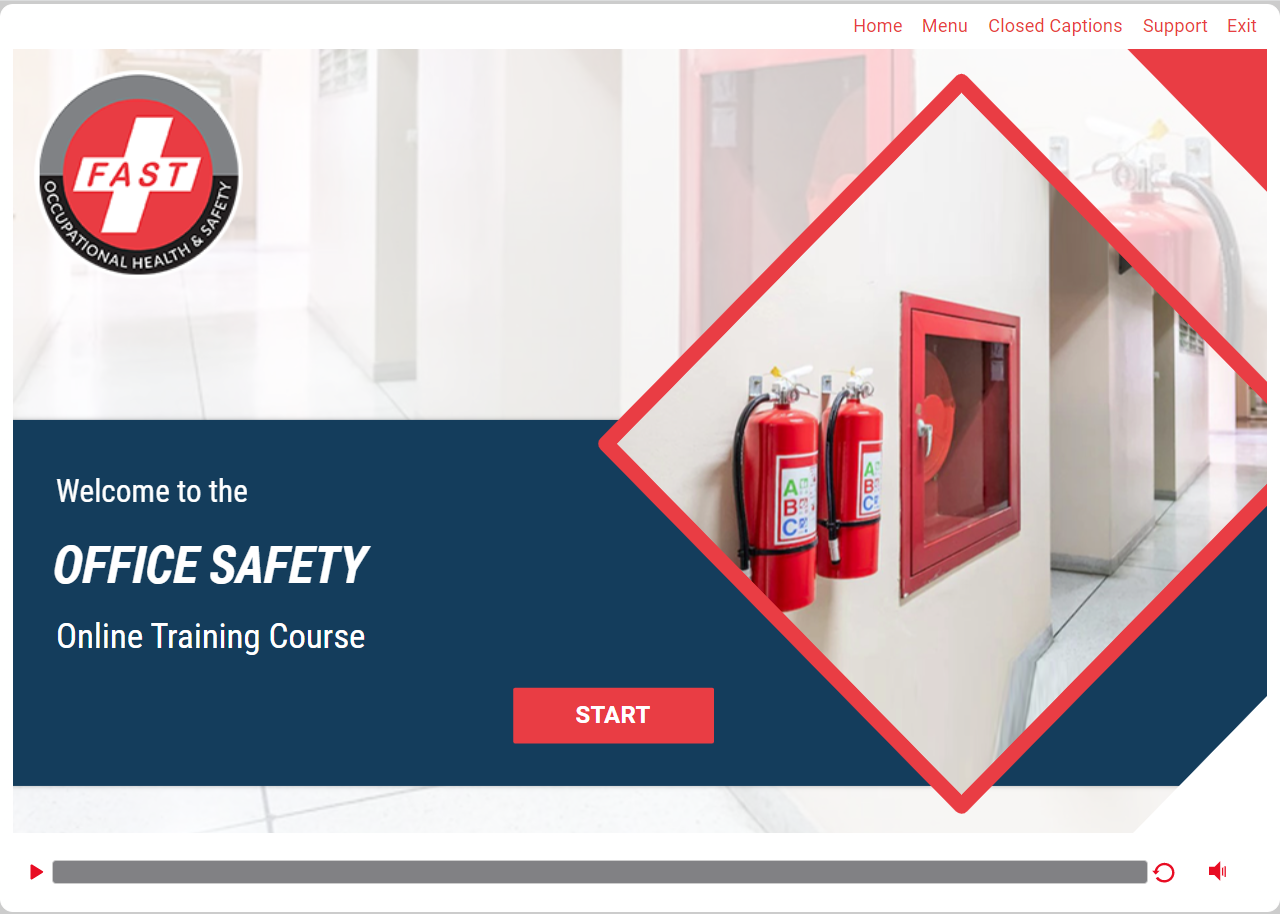
Occupational Health and Safety (OHS) – Office Safety Training Online Program
The course is fully narrative and AODA compliant. The topics are explained in detail, represented by relevant images and activities to confirm understanding.
At the end of the module, there is a final test to gauge learners understanding.
OFFICE SAFETY TRAINING ONLINE COURSE OUTLINE
The course covers the following topics:
1. OBLIGATIONS UNDER THE LAW – OHSA
Obligations under the law, specifically under the Occupational Health and Safety Act (OHSA), refer to the responsibilities and legal requirements that individuals and organisations must adhere to ensure a safe and healthy working environment.
1. Employer’s Duty to Provide a Safe Workplace
2. Appoint Competent Supervisors
3. Other Employers Duties
2. THREE RIGHTS
The chapter describes the “Three Rights” that workers have regarding workplace safety. The first right is the right to know about the dangers present in their workplace. This means that employers must inform their employees of any potential hazards or risks associated with their job duties.
The second right is the right to participate in the health and safety program in their workplace. Workers have the right to be a member of the Joint Health and Safety Committee and to participate in training related to workplace safety.
The third right is the right to refuse unsafe work. This means that if an employee believes that their work is unsafe or could cause harm to themselves or others, they have the right to refuse to do the work until the hazard is corrected.
It is important to note that there are some exceptions to these rights in certain circumstances, such as in healthcare, firefighting, and policing. However, in general, these rights are protected by law (QHSA S.43-S.49) and employers must take steps to ensure that their employees are aware of and able to exercise these rights.
3. WORK REFUSAL
Work refusal is the act of an employee choosing not to perform a specific task or duty due to concerns about the safety or health risks associated with it. The chapter describes the circumstances under which a worker has the right to refuse work. According to the Occupational Health and Safety Act, a worker may refuse to do a job if they believe that any equipment, machine, device, or thing they are required to use or operate is likely to endanger themselves or others.
Additionally, workers may refuse work if they believe that the physical condition of the workplace or a part there of is likely to endanger themselves or others. This can include issues related to building condition, housekeeping, or other physical hazards.
Finally, if workers believe that there is a contravention of the Occupational Health and Safety Act in their workplace, they may also refuse work.
Apart from work refusal, also learn about the following in detail:
1. Report of a Refusal
2. Roles and Responsibilities for all Workplace Parties
4. ROLES AND RESPONSIBILITIES
Roles and responsibilities refer to the specific duties and tasks assigned to individuals within an organisation.
1. Supervisor/Manager Responsibilities
2. Workers’ Responsibilities
5. HEALTH AND SAFETY COMMITTEES & REPRESENTATIVES
Health and Safety Committees and Representatives are groups or individuals within an organisation dedicated to promoting and maintaining a safe and healthy working environment. This chapter describes the requirements under the Occupational Health and Safety Act (OHSA) regarding the need for a health and safety representative or a joint health and safety committee (JHSC) in the workplace, depending on the number of workers employed.
Specifically, it states that workplaces with 6-19 workers must have a health and safety representative, while those with 20 or more workers must establish a JHSC.
The purpose of these requirements is to ensure that workplaces maintain a safe and healthy environment for their employees by having a designated representative or committee responsible for identifying and addressing potential hazards and promoting safety practices.
6. MINISTRY OF LABOUR, TRAINING AND SKILLS DEVELOPMENT (MLTSD)
The Ministry of Labour, Training and Skills Development (MLTSD) is a government department responsible for overseeing labour relations, workplace safety, and skills development. This chapter provides an overview of the Ministry of Labour, Training and Skills Development (MLTSD), which was established in 1919 as the Department of Labour.
The MLTSD is responsible for enforcing workplace safety laws and regulations, developing strategies to prevent workplace injuries, and ensuring that employers comply with the regulations.
It also states that employees who feel that their employer is taking action against them for raising health and safety concerns can file a complaint with the Ontario Labour Relations Board. Overall, the chapter emphasizes the importance of the MLTSD in protecting workers and ensuring safe workplaces.
7. HEALTH & SAFETY PARTNERS
Health and Safety Partners are individuals, organisations, or entities that collaborate to enhance and maintain a safe and healthy working environment. Learn about the health and safety partners that have been mentioned in this chapter in the bulleted points.
8. WORKPLACE SAFETY AND INSURANCE BOARD (WSIB)
The Workplace Safety and Insurance Board (WSIB) is a government agency responsible for overseeing workplace safety and providing compensation and insurance coverage for workers who are injured or become ill on the job. This chapter provides an overview of how the Workplace Safety and Insurance Board (WSIB) works to support both employers and workers in Ontario.
It explains that WSIB provides no-fault collective liability insurance to employers, which includes access to industry-specific health and safety information.
For workers, WSIB provides loss of earnings benefits and health care coverage in case of injury.
This chapter also highlights that WSIB offers support and assistance to both workers and employers when it is time to return to work after an injury.
Overall, the chapter emphasizes the importance of WSIB in promoting workplace safety and providing support to both employers and workers in Ontario.
9. DUE DILIGENCE
In this chapter, you will learn about the following:
1. What is required?
2. What is Due Diligence?
3. Why is it Important?
10. R.A.C.E
1. Recognizing hazards: Recognizing hazards involves identifying and understanding potential dangers or risks in a given environment or situation.
2. Types of Hazards: Types of hazards are the various categories or classifications of potential dangers that can exist in a particular environment.
3. Assessing hazards: Assessing hazards involves evaluating and analysing potential dangers or risks in a given environment.
4. Determining level of risk: Determining the level of risk entails evaluating the likelihood and potential impact of identified hazards in a specific situation.
5. Controlling hazards: Controlling hazards involves taking actions to manage or eliminate potential dangers identified in a particular environment.
6. Evaluating: Evaluating is a critical assessment process, ensuring effectiveness and providing insights for improvement.
11. INSPECTION OF HAZARDS
Inspection of hazards is a systematic examination of a workplace or environment to identify and assess potential dangers.
1. Workstations: Workstations are designated areas or spaces within a workplace where employees carry out their tasks.
2. Chairs and Desks: Chairs and desks are essential pieces of furniture in a workspace, providing seating and work surfaces for individuals to perform their tasks comfortably.
3. Computers: Computers are electronic devices used for processing, storing, and managing information.
4. Lighting: Lighting refers to the arrangement and use of artificial or natural light in a workspace.
5. Noise: Noise is unwanted or disruptive sounds present in a workplace.
6. Ventilation: Ventilation is the provision and circulation of fresh air within a workspace.
7. Stacking and Storage: Stacking and storage involve the organized arrangement and safekeeping of items within a workspace.
8. Filing Cabinets: Filing cabinets are storage units designed to organize and store documents or files in a systematic manner.
12. ELECTRICAL SAFEGUARDING
Electrical safeguarding involves the measures and precautions taken to ensure the safety of individuals and equipment from potential hazards associated with electrical systems. The chapter emphasizes the importance of regularly checking the condition of cables, plugs, and wires to ensure they are in good working condition.
It advises that damaged or frayed cables and wires could pose a hazard and may not function properly. The message suggests that regular checks can help prevent accidents or other problems that may arise from faulty cables or wires.
13. USING OFFICE EQUIPMENT
1. Office Machines: Office machines are electronic or mechanical devices used to perform various tasks and functions within a workplace.
2. Manual Handling: Manual handling involves the physical lifting, moving, or carrying of objects or materials by individuals in a workplace.
3. Office Security: Office security encompasses measures and protocols implemented to safeguard the physical, digital, and personnel aspects of a workplace.
14. ACCIDENT INVESTIGATION
1. Slips, Trips, and Falls: Slips, trips, and falls are accidents that occur when individuals lose their footing, stumble, or lose balance, resulting in a fall.
2. Stairs: Stairs are inclined steps or a series of steps that provide passage between different levels of a building or structure.
3. Glass: Glass is a transparent or translucent material made by melting sand and other substances.
4. Back Injuries: Back injuries are harm or damage to the rear part of the body, particularly the spine, muscles, or nerves.
5. First Aid Box: A first aid box is a designated container or kit containing essential medical supplies and equipment used to provide initial care for injuries or illnesses.
6. Fire Safety: Fire safety is the implementation of measures and practices to prevent, control, and respond to fires in order to protect lives and property.
7. Hygiene Facilities: Hygiene facilities are designated areas or amenities within a workplace that support and promote cleanliness and personal well-being.
15. VIOLENCE
Violence is the intentional use of physical force or the threat of force to cause harm, injury, or damage. In a broader context, it can also encompass verbal or psychological aggression aimed at causing distress or fear.
1. What is workplace violence?
2. Identify workplace violence
3. Acts of Violence
4. Bullying
16. WHMIS AT YOUR WORKPLACE
1. Employers
2. Workers
17. WHMIS HAZARD SYMBOLS
1. WHMIS Labels
2. SDS
3. Hazardous Substance
4. Hazardous Consumer Products
5. Labels – Back Panel
6. Degree of Hazard
7. Occupational Illness (OI)
8. Final Thoughts
- Office Safety
- Download Certificate
Student Reviews
Feedback from students who have taken this course.