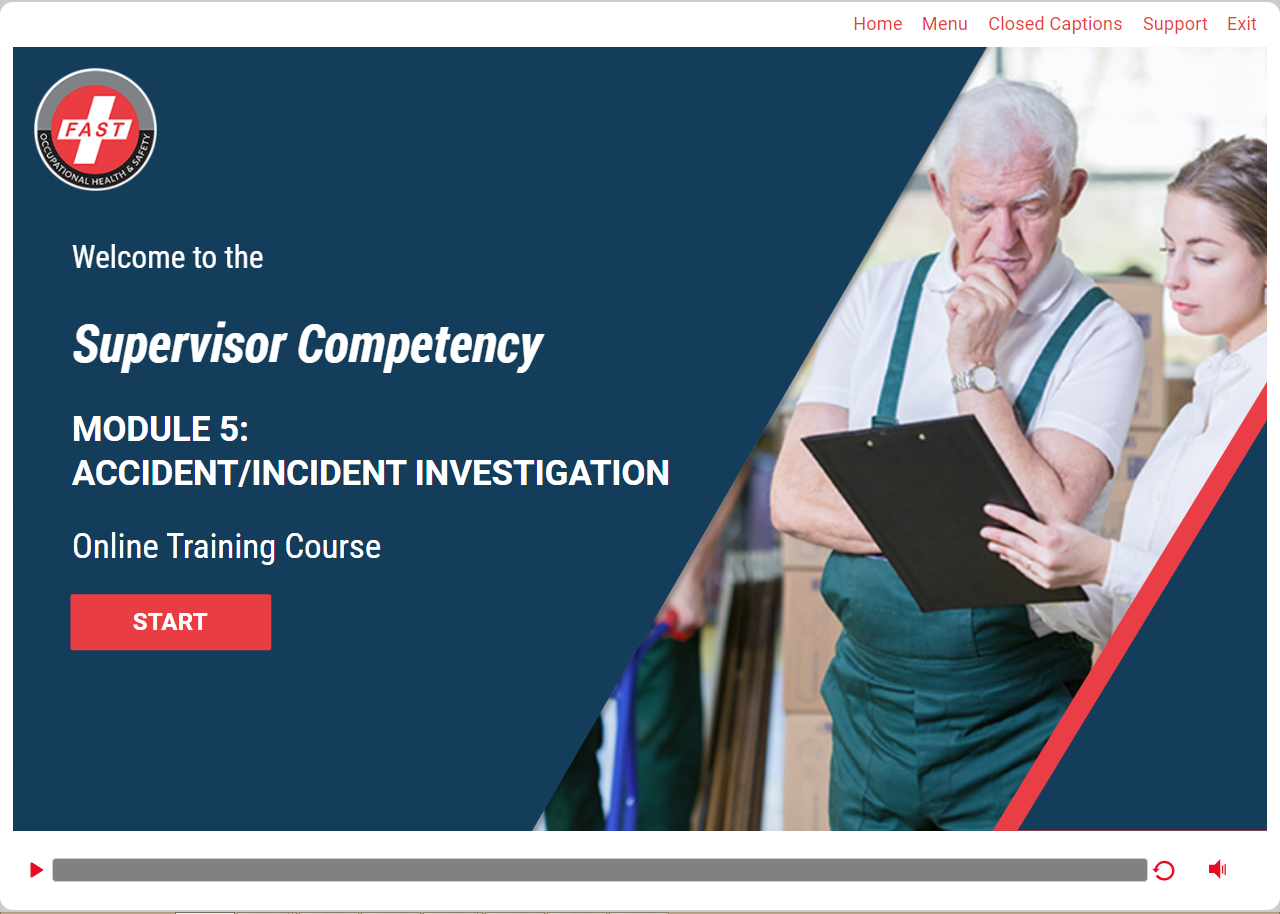
Supervisor Awareness
(E-SSAT-E)
Introduction to Supervisor Awareness Online Training Course
Occupational Health and Safety (OHS)—Supervisor Competency Training Online Course
Course Overview
This course consists of five training modules, which offer a perspective on the competencies that supervisors require in order to achieve superior workplace management.
These five modules include:
1. Introduction to Supervisor Competency
2. Supervisor Safety Training
3. Supervisor Safety Training – Continued
4. Workplace Inspections for Supervisors
5. Accident/Incident Investigation
SUPERVISOR COMPETENCY TRAINING COURSE OUTLINE
The course covers the following topics:
1. Introduction to Supervisor Competency
- Preface
Introductory chapter describes the significance of supervisor competencies in enhancing specific knowledge, skills, abilities, and behaviour within the workplace. - What is Competency?
Learn what is competency, why core competencies are essential, and who is a competent person according to the Occupational Health and Safety Act (OHSA). - Why are Competent Supervisors Important?
In this chapter, learn why competent supervisors are important for the wellbeing of employees and an organization. - What Makes a Competent Supervisor?
This chapter mentions the specific duties for workplace supervisors which are set out by the Act. - What the Act States?
This chapter is about legal obligations, guidelines, duties and additional duties that the OHSA has prescribed for an employee to be appointed as a supervisor. - What Supervisor Competencies Do?
This chapter lists out all the roles and responsibilities of a supervisor. - Being a Leader
This chapter lists out the overall duties of a competent supervisor and explains the qualities required while performing these duties.• Establish goals and objectives for the worksite
• Provide oversight and guidance at the worksite
• Lead by example
• Demonstrate integrity
• Promote a positive health, safety and environmental culture
• Provide motivation and recognition
• Encourage teamwork
• Facilitate worker participation
• Manage accountability
• Manage time and priorities
• Manage change
• Solve problems
• Manage conflict resolution
• Make decisions within level of authority
• Provide coaching of other supervisors and workers
• Delegate authority and responsibility
• Ensure compliance to company, industry and regulatory standards
• Manage risk and conduct risk assessments
• Identify opportunities for improvement - Being a Leader: Best Practices
Learn about all the additional duties and responsibilities that a competent supervisor needs to perform. - Leadership Skill Requirements
Learn about all the skills that a supervisor needs to know about, such as:• Companies vision, values and principles
• Technical and industrial practices and procedures
• Performance and management techniques
• Conflict management techniques
• Industry practices and guidelines - Supervising New and Young Workers
Young workers and new workers of any age are often keen and can bring new ideas and renewed energy to your workplace. - Factors Contributing to Higher Incident Rates
This chapter explains why new and young employees face more hazardous situations such as having little work experience, being unaware of the hazards, lack of adequate education, training and supervision. - Supervisor’s Obligation
Learn in this chapter about the supervisor’s obligations provided by Ontario’s Occupational Health and Safety Act (OSHA). - Encourage the Right Behaviour
This chapter explains how employees sometimes unknowingly encourage risky behaviour by favouring silent, low maintenance go-getters who don’t ask a lot of questions. - General Duties of Supervisors
Learn the general duties of supervisors listed in this chapter with relevant images. - Effective and Diligent Supervisors
This chapter covers guidelines to be followed by a supervisor. - Due Diligence
In this chapter, you will learn about the systematic approach that provides instruction, training, supervision, verification of knowledge, and correction of physical and human hazards. - Due Diligence Checklist
This chapter provides a detailed due diligence checklist to ensure that the response is affirmative for each check point. - Basic Elements of Due Diligence Supervision
Learn about the basic elements of due diligence that supervisors should take care of to ensure that everything is in order. - Consequences of Poor Diligence
This chapter highlights the consequences of poor diligence that was introduced by Bill C45 in March 2004, as new federal legislation. - Criminal Negligence
Learn how section 219(1) of the Criminal Code defines criminal negligence as showing wanton or reckless disregard in performing any duty or omitting to perform any duty required by law. - Who is affected by Bill C-45?
In this chapter, you will learn who will be affected by Bill C-45, and the types of organizations that are included in the list. - Provincial Fines and Penalties
This chapter outlines the provincial fines and penalties for individuals and corporations. For individuals, the details of imprisonment are provided. - Which Offences are targeted by Bill C-45?
Learn about the four cases where individuals were charged under the new provisions in the Criminal Code. - Where the MLTSD Began?
This chapter provides information about when the Ministry of Labour, Training and Skills Development came into existence and their responsibilities. - Changes to OHS in Ontario
In this chapter, learn about the changes to OHS in Ontario that were taken into consideration based on the industrial safety act of 1964. - How is Legislation Enforced?
This chapter explains that Enforcement begins with issuing of orders and may proceed to prosecution. The chapter also discusses the roles of the inspectors of the Ministry of Labour. - Inspectors
This chapter lists out the personnel against whom the inspector can initiate a prosecution. - Inspectors Carrying Out Inspections
In this chapter, you will learn about the authorities that an inspector has for carrying out his or her duties. - Full Cooperation
You will learn that under the Act, it’s a major responsibility of every individual to cooperate fully with inspectors in performing their duties. - Ticketing
Learn about the ticketing issued by MLTSD inspectors for certain violations, and also about different fines. - Occupational Health and Safety Ticketing
Occupational health and safety ticketing is highlighted in this chapter as a result of investigating a complaint, an injury, or a work refusal. - Fines
All the details about the fines are given in this chapter along with a web link for knowing the complete listing of fines.
2. Supervisor Safety Training
- Hazard Definition
This chapter briefly defines what a workplace hazard is and provides information about categories of hazards. - Worksite Inspections
In this chapter, you will learn about the machinery and equipment that is inspected frequently by a supervisor. - Purpose
The inspection process involves carefully examining work areas on a regular basis. In this chapter, you will learn the purpose of this inspection in detail. - Hazard Assessment
Learn about the four hazard assessment based on which high, medium and low levels of risks are determined. - Aspects to Examine
In this chapter, you will learn the various aspects to examine in the workplace. - Hazard Classification
In this chapter, you will learn about the five forms of hazards – Chemical, Safety, Biological, Physical and Ergonomic. - Controls
Learn about the control management system by considering the source, the path and the worker, such as Elimination, Isolation, Modification and Substitution. - Evaluation
This evaluation chapter suggests identifying what is working and what is not, to make corrections to your hazard assessment program. - What is the JHSC?
Learn about the JHSC (Joint Health and Safety Committee) along with its brief information that is applicable to deal with health and safety issues. - What is the Internal Responsibility System?
This chapter discusses the responsibilities for employers and employees to ensure a safe and disease-free workplace. - The JHSC’s Role to the IRS
In this chapter, you will learn about the role of JHSCs and IRS working levels in accident and incident reviews and workplace inspections. - How Does the IRS Work?
The IRS key tasks are highlighted in this chapter along with other details such as Internal Responsibility System and Keys to a Successful IRS. - Three Rights
In this chapter, you will learn the three rights – right to know, right to participate and right to refuse – that assist in the health and safety of your workplace. - Exceptions for Refusing Work
Learn about the circumstances that empower a worker’s right to refuse unsafe work. - Work Refusal Stages – One, Two, and Three
This chapter covers different work refusal stages such as Work Refusal Stage
One, Work Refusal Stage Two and Work Refusal Stage Three. - Documentation
In this chapter, a thorough documentation process is given that needs to be done for work refusal. - Personal Protective Equipment
This chapter includes information on PPE and its overall use for employees. - PPE Selection
In this chapter, you will learn about various equipment that needs to be taken into account, such as masks, respirators, eye safety, gloves, and footwear for PPE selection. - WHMIS Regulation
This chapter covers the WHMIS regulations concerning labels, safety data sheets, and worker training programs regarding hazardous materials in the workplace. - Employers/ Supervisors
Learn about the responsibilities of employers and supervisors regarding the containers of controlled products, SDS from suppliers, and training programs. - Workplace Hazardous Materials Information System
This chapter covers WHMIS training about hazardous materials in the workplace (labels, safety data sheets, workplace-specific training). - What is a Toxic Substance?
In this chapter, you will learn what a toxic substance is and the two purposes that deal with toxic substances. - Supervisor Responsibilities Concerning Hazardous Materials
This chapter describes supervisor responsibilities in identifying hazardous materials and providing safety data sheets (SDSs). - Identifying Hazardous Material
Learn how to identify hazardous materials in accordance with WHMIS regulations to prevent damage. - Safety Data Sheets
In this chapter, you will learn the general duty of an employee to either obtain or prepare unexpired SDSs for hazardous materials in the workplace. - Legislation
This chapter covers spill response falls under different bodies of legislation. - Ministry of the Environment
Learn the standard definition for a minor spill based on the ministry of the environment. - Classification of a Minor Spill
In this chapter, you will learn the classification of a minor spill that is highlighted in an easy-to-understand manner. - Response to a Minor Spill
This chapter highlights the detailed description in response to a minor spill followed by handling the hazardous material and clean-up process. - After the Clean-up
In this chapter, you will learn all the things that need to be taken into consideration after the clean-up process. - Lockout/Tagout Written Procedures
Learn about the lockout/tagout information that workers need to know to control hazardous energy during service or maintenance. - What is a Musculoskeletal Disorder (MSD)?
Learn about the musculoskeletal disorder in this chapter and the following chapters (listed below) cover the related topics:• How Do MSDs Develop?
• Risk Factors
• Types of MSD Injuries
• Mechanics of an MSD Injury
• Why Be Concerned with MSDs? - Ergonomics
Learn what is ergonomics and the factors where Ergonomics evaluates risks such as work, organizational, biological, physical and psychological. - Types of Controls
This chapter covers various types of controls such as engineering, administrative, and personal protective equipment (PPE). - Supervisor’s Responsibilities
In this chapter, you will learn the responsibilities of a supervisor regarding MSD hazards. - Tips for Prevention
Learn the prevention tips such as healthy diet, balanced lifestyle, avoiding sleep deprivation, and daily exercises to stay fit and healthy.
3. Supervisor Safety Training – Continued
- Duty to Accommodate
The duty to accommodate is a legal requirement, per sections 2 and 15 of the Canadian Human Rights Act. Learn what these sections say about duty to accommodate. - WSIB Forms
In this chapter, you will learn about various WSIB forms related to different acts. A web link is also provided where you can access all these forms. - Form 7
In this chapter, you will learn how Form 7 is used for different purposes. - When to Use the Form 7
Learn the correct usage of Form 7 based on different situations. - Do Not Use the Form 7 to…
In this chapter, you will learn about the situations where Form 7 should not be used. - Penalties for Late Filing
Learn about the penalties for late filing Form 7, incomplete form, failure to provide a copy to the worker etc. - Need Help with the Form 7?
WSIB (Workplace Safety and Insurance Board) has produced a reference guide for employees. This chapter explains how it can be used. - Poor Functional Form Completed
This chapter talks about the assistance available from WSIB to obtain more useful information. - What is Bill C-99?
The spirit of Bill C99 is that employers and injured workers are to work cooperatively to determine abilities and modified work. - Non-Medical ESRTW
The early and safe return to work (ESRTW) process helps you to continue working after an injury or to return to work in a safe and timely manner if you take time off. - Employer’s Continuity Report
This chapter discusses the procedure to follow when reporting to the respective person for any queries. - Employer’s Exposure Incident Form – 3959A
In this chapter, learn information regarding the exposure incident to chemical or other substances, experienced by the worker. - Pre-Injury Phase
Learn about the pre-injury phase and the need to ensure if they are physically fit to perform the tasks required. - Communication Prior to Injury
In this chapter, learn how to communicate annually based on the questions provided. - Pre-Injury Training
Learn about the pre-injury training needed for the health and safety of the supervisors and managers. - Day of Injury
Learn about all the instructions that you need to take in case of an injury. - During Recovery
In this chapter, you will learn the importance of communicating with the injured workers during recovery and what duties need to be managed while the injured person is at home. - Communication
Learn with whom you need to communicate in case of injury and recovery. - Union Responsibilities in ESRTW
In this chapter, you will learn about the union responsibilities in ESRTW and their role in identifying suitable candidates for their job tasks. - Red Flags
In this chapter, you will learn about the situations when you need to raise a red flag regarding worker’s injury and recovery. - Hints and Tips
Learn various hints and tips that will assist you in performing your job more effectively while handling workers’ injuries. - Harassment and Violence
Learn in this chapter what Ontario Human Rights Code, Bill 168 hold about harassment. - Four Types of Harassment and Violence
This chapter explains four types of harassment and violence: Criminal intent, client, worker-related and personal relationships. - Bill 168
Learn details about Bill 168 – since when it has been effective, the purpose of its origin and the changes it suggested to prevent workplace violence and harassment. - Workplace Violence
In this chapter, know what exactly is workplace violence. - Workplace Harassment:
Be aware of various forms of workplace harassment such as bullying, intimidating or offensive jokes or innuendos, displaying or circulating offensive pictures or material and intimidating phone calls. - Union Responsibilities
In this chapter, you will learn about union responsibilities in violence and harassment investigations in addition to other relevant useful information. - Violence and Harassment
In this chapter, you will learn about the sections regarding violence and harassment such as domestic violence: - Final Test
At the end of the module, there is a final test in the form of multiple choice questions.
4. Workplace Inspections for Supervisors
- Introduction
This chapter describes how performing workplace inspections is important for the overall health and safety. - Purpose
In this chapter, you will learn different things which are the targeted activities for the regular supervisor workplace inspections. - Aspects to Examine
Learn various aspects to examine workplace inspection in order to develop a safe and healthy work environment. These aspects include who, what, where, when, how and why. - Workplace Elements
In this chapter, learn about workplace elements such as Environment, Equipment, and Processes. - Environment
You will learn in detail about the environment hazards such as noise, vibration, temperature, ventilation. - Equipment
The course also discusses about the equipment hazards such as materials, tools and apparatus. - Process
This chapter explains how a worker completing a task in an environment or using equipment may pose a hazard and the process involves carefully examining work stations on a regular basis. - Hazard Classification
Learn the various forms of hazards, such as• Safety
• Biological
• Chemical
• Ergonomic
• PhysicalIn this chapter, hazard classification has been described using relevant images.
- Inspection Program
This chapter covers how to set up a good inspection program using four steps:• Planning
• Physical Inspection
• Writing Reports and recommendations
• Follow Up - Step One: Planning
In this chapter, each and every component of workplace inspection, including equipment, work processes, and practices, has been covered. - Step Two: Inspection
This chapter describes the need for inspection in areas such as, offices, storage areas, maintenance areas, cafeterias, and locker rooms. - Step Three: Writing
In this chapter, you will learn about report writing to obtain management support for observations made as a result of inspections. - Recommendations
In this chapter, learn the recommendations to make inspection worthwhile and productive. - Step Four: Follow Up
Follow Up is the best way to accomplish proper control in identifying and preventing workplace hazards.
5. Accident/Incident Investigation
- Introduction
This introductory chapter describes how accident and incident investigation plays a significant role in hazard identification and control programs in the health and safety system. - Due Diligence
In this chapter, you will learn about the precise definition of “due diligence” and how it takes into account all reasonable care to protect the health and safety of all workers. The chapter reiterates that employees must be able to demonstrate their due diligence in an objective manner. - Legislation
In this chapter, learn the guidelines related to preservation and notification of an accident established by the Occupational Health and Safety Act (OHSA).Written report required by OHSA sec 51 are also included.
- Definitions
To clearly understand the differences between an accident and incident or a critical and noncritical injury, it is necessary for you to know the proper definitions. - Responsibilities
Learn about the responsibilities of Joint Health and Safety Committee (JHSC) to investigate cases where a worker is killed or critically injured in the workplace. - Investigation Process
In this chapter, learn the nature of investigation process in preventing workplace hazards or accident/incident injuries. - The Steps
In this chapter, learn the steps to accident investigation that should be followed to investigate workplace injury cases effectively. - Take Immediate Action
In this chapter, know about the situations which are considered for immediate action, followed by important points. - Gather Evidence
This chapter covers gathering evidence including when to gather, methods of gathering evidence, sketching tips, photograph taking tips, collecting information, who to interview, categorizing witnesses. - Put the Evidence in Order
In this chapter, learn all the facts to put the evidence in order to develop a mental picture of what happened. - Analyze the Information
In this chapter, learn how to analyse information based on the information provided along with the root causes. - Recommendations for Corrective Actions
Learn about the recommendations that are listed in this chapter. - Follow Up
In this chapter, you will learn the information that will help you make follow up on subsequent incident investigations. - Write an Investigative Report
In this chapter, learn about how to write an investigative report by taking all the given points into consideration. - Theories of Accident Causation
Know different theories such as Heinrich 1930’s, Iceberg theory along with their graphical and diagrammatic representations. - Analysis
Learn the detailed analysis of an accident under three cause levels. - Causal Factors
Learn the three causal factors, i.e. Direct Causes, Indirect Causes, and Basic Causes along with appropriate images. - Accident Investigation
In this chapter, learn how to prevent accident investigation by having a glance at the given flow chart of causal factors. - Determining the Cause
Here, learn the factors that can be used to investigate the cause of an accident. - Material
In this chapter, learn how machines, tools, and equipment are used by the workers. - Environment
This chapter describes the physical workplace environment along with factors that need to be taken into consideration. - Personnel
Learn in this chapter the factors that an individual must consider while performing their job responsibilities. - Management
Learn about the role of management and significant factors that should be considered in an accident investigation. - Task
In this chapter, learn what a task exactly is. - Notification
Learn about the detailed notifications i.e. notice of death, critical injury, notice of accidents etc. in this chapter. - Final Thought
In this chapter, you will know the final thought of this module, “It’s a fact finding mission to prevent repeat injuries”. - Conclusion
This chapter concludes that, “this training is an overview of the knowledge, skills and abilities that you will need to achieve in order to become a competent supervisor, and be able to protect your workers from the day to day hazards that they face within the workplace.”
- Supervisor_Awareness_M1
- Supervisor_Awareness_M2
- Supervisor_Awareness_M3
- Supervisor_Awareness_M4
- Supervisor_Awareness_M5
- Download Certificate
Student Reviews
Feedback from students who have taken this course.