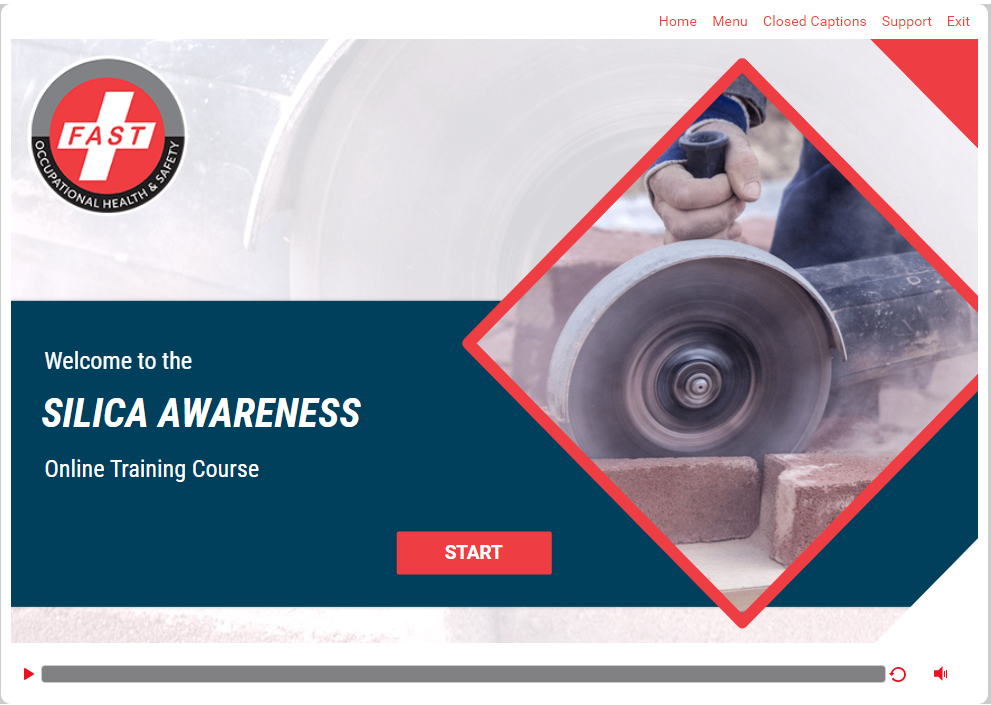
Silica Awareness
(E-SSLA-E)
Introduction to Silica Awareness Training Online Training Course
Occupational Health and Safety (OHS) – Online Silica Awareness Online Training Program
Once you start the course, you can pause it as needed. The course will automatically bookmark and you can resume it where you left off.
The course is fully narrative and AODA compliant. The topics are explained in detail, represented by relevant images and activities to confirm understanding.
At the end of the module, there is a final test to gauge learners understanding.
SILICA AWARENESS ONLINE TRAINING PROGRAM COURSE OUTLINE
1. SILICA
Silica is a natural mineral found in materials like sand, rock, and soil. It is commonly encountered in various industrial processes. In this chapter, you will learn briefly about silica and its states.
2. WHEN IS SILICA DANGEROUS?
Silica is dangerous when its fine dust particles are inhaled, usually during activities like cutting or grinding materials such as sand or rock. While materials that contain crystalline silica may not be hazardous in their natural state, they become dangerous when they are disturbed, generating small-sized particles that can be breathed in and get lodged in the lungs.
This type of silica is known as “respirable crystalline silica”. Silica can become hazardous during various activities, such as blasting, cutting, chipping, drilling, and grinding materials that contain silica.
These activities can create silica dust that can be hazardous to employees and others in the area. Inhaling silica dust can seriously compromise an employee’s health, leading to lung diseases such as silicosis, cancer, and an increased risk of tuberculosis (TB) infection. Therefore, it is important for employees and employers to take the necessary precautions to minimize exposure to silica dust in the workplace.
3. WHERE IS SILICA FOUND IN THE WORKPLACE?
Silica can be found in various workplaces, particularly in industries that involve working with materials like sand, rock, or concrete. Crystalline silica has played a significant role in human history, especially in industrial development. Its earliest use dates back to three to five thousand years BC, where it was used in metallurgical and glass-making activities.
Since then, it has been a crucial raw material in the development of several industries, including glass, foundry, and ceramics. Even in modern times, silica continues to contribute to the progress of humanity.
Its application in information technology is remarkable, as it provides the raw material for silicon chips and is used in the plastics of computer mouses. The importance of crystalline silica in industrial development and modern technology is undeniable, and it will likely continue to play a crucial role in shaping human progress in the future.
4. WHAT ARE THE HEALTH EFFECTS OF SILICA?
Inhaling silica dust, common in activities like cutting or grinding materials, can lead to respiratory issues such as silicosis, chronic bronchitis, and an increased risk of lung cancer. Silicosis is a severe and debilitating lung disease that can be caused by inhaling crystalline silica.
This disease is irreversible and, in some cases, can be fatal. When silica particles are inhaled by an employee, the lungs respond by creating hard nodules and scarring around the trapped particles.
Over time, this can lead to significant damage and breathing difficulties. If the nodules become too large, they can obstruct the airways, leading to a loss of lung function and even death. It is important to take measures to prevent the inhalation of crystalline silica to avoid the development of this life-threatening disease.
Employers should provide proper protective equipment and training to their employees to minimize their exposure to this hazardous material.
Apart from it, the course outlines the following:
1. Types of silicosis
2. Written exposure control plan
3. Control measures to reduce silica exposure
4. Handling and storage practices used when working with silica
5. Accidental release measures for silica
6. First aid measures for silica exposure
5. SUMMARY
Silica awareness training is a critical component of workplace safety. By providing employees with the knowledge and skills to recognize and prevent silica exposure, employers can create a safer and healthier work environment for everyone.
6. FINAL TEST
Final test evaluates learners understanding and knowledge gained from the training. It includes questions on the roles and responsibilities of the committee members, meeting procedures, safety regulations and standards, and emergency response protocols.
The test may be in the form of multiple-choice questions, or choosing the correct answers. The final test is essential to ensure that the learners have comprehended the training’s key concepts and can apply them in the workplace.
- Silica Awareness
- Download Certificate
Student Reviews
Feedback from students who have taken this course.